Gasping for Air.
The news about Cesar Chavez & Dolores Huerta took my breath away.

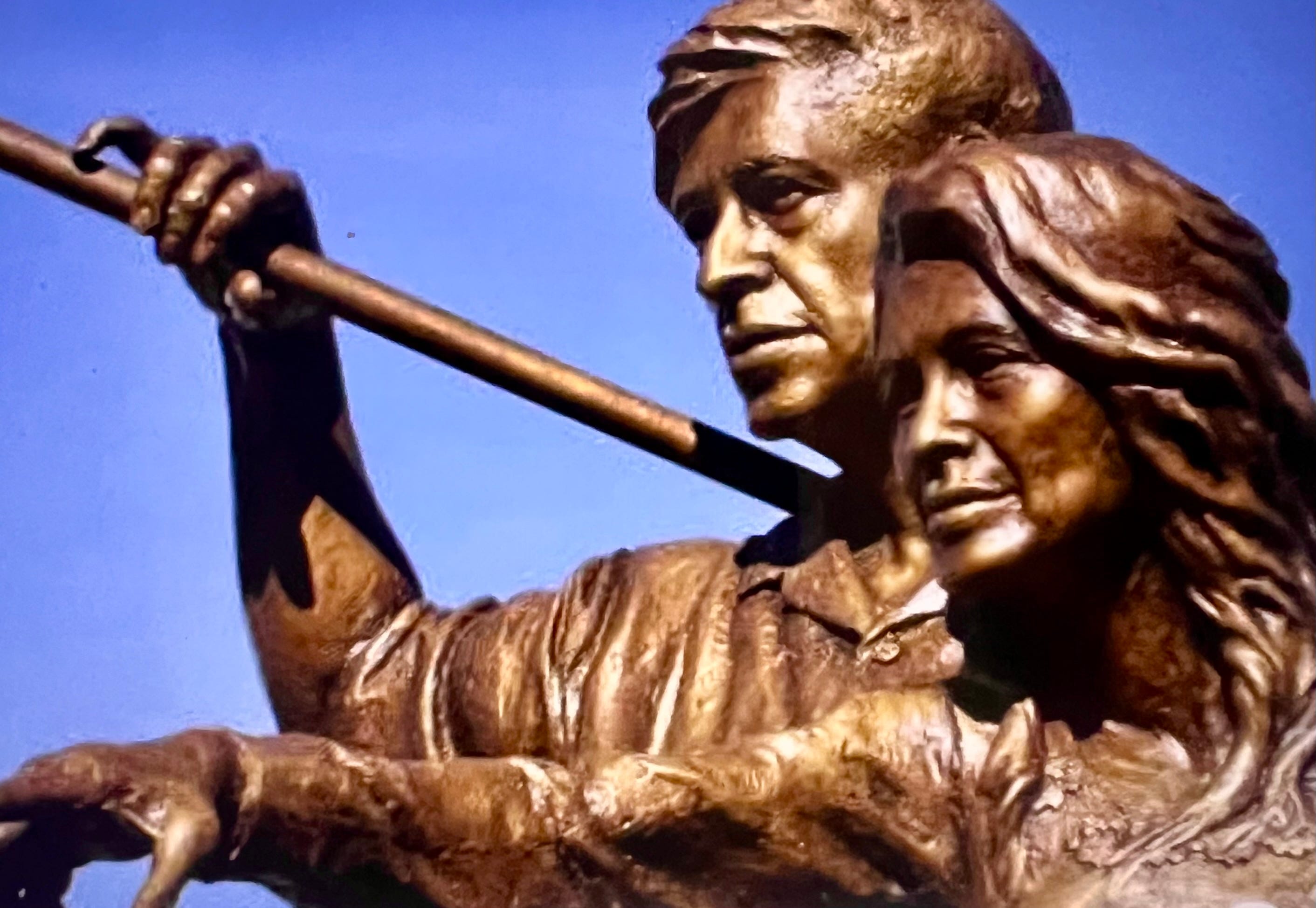
(The Napa County, CA., Sculpture of Cesar Chavez and Dolores Huerta, by Napa sculptor Mario Chiodo. Photo by the Napa Valley Register)
I woke up the morning I learned the news and couldn’t catch my breath.
No, it wasn’t because of my age; it wasn’t because almost daily now, I hear of another old friend or former colleague getting a debilitating disease or disability, or dying.
It wasn’t because another school full of young, innocent Muslim girls was obliterated, or a high-rise residential apartment tower in the heart of Beirut, Lebanon, blown to bits by Israeli terrorists—masquerading as a government—with each floor pancaking upon the one below it, crushing into dust any humans still inside.
It wasn’t because something bad had happened, God forbid, to one of my granddaughters or my son or my partner of 54-years. Those are a steady drumbeat of worries, which always come in bunches, and not as single spies. That is the background music to my life; a constant hum.
And, no, it wasn’t because of another all-too real series of night terrors of mine, where I raced against time to prevent a bomb from going off, or spent the darkness loudly cursing out Trump or Bondi or Bibi or Hegseth or a long litany of monsters, until my shouts awakened others to how conscious my unconscious had become.
What made me gasp for air this time, was a headline in the on-line New York Times confirming disturbing rumors we heard about Cesar Chavez, the day before, but tried to dismiss because there were no credible sources for those rumors, and we know how anything can be made up by anyone, anywhere at anytime and become what passes for fact, instantly.
Only this morning, the source could not be more credible: it was Dolores Huerta, Chavez’ co-leader of the United Farm Workers union, and, at 96, the living heart and soul of the movement for social & economic justice for more than 65 years.
There was the New York Times headline: “Cesar Chavez, a Civil Rights Icon, Is Accused of Abusing Girls for Years.” And there were the sources: Ana Murguia, Debra Rojas—two women raped by Chavez when they were young girls in the 1970’s; and Dolores Huerta, Chavez’ most prominent female ally in the Farm Workers Movement, and a labor-movement icon in her own right.
Dolores Huerta, 96 years old, who suffocated a secret for 60 years, of having been raped by Cesar Chavez, on more than one occasion, resulting in two pregnancies—which she hid—and the birth of two daughters, whom she gave away to be raised in more stable family settings. This was Cesar Chavez. This was Dolores Huerta. Two pillars of my life from my early years of college; two symbols of the urgency of struggle to bring about sweeping social change; two working-class heroes.
Pulitzer Prize winning journalist Melinda Henneberger was eloquent in her excruciatingly painful description of the torment which Huerta had hidden for six decades, in her Substack column entitled Kansas City Stack, headlined: “Why did Dolores Huerta wait 60 years to accuse César Chávez of rape? I hope I know the answer:
‘Ms. Huerta broke down, sobbing and wailing’
From the Times story:
Ms. Huerta said he abused her not only physically but emotionally. Union records document an argument at La Paz between the two of them over missing financial receipts during a board meeting in 1979. Ms. Huerta demanded respect and pushed back against his suggestions that she had stolen money. Mr. Chávez responded by shouting at her with curses and insults, repeatedly calling her a stupid bitch, according to the audio recordings of board meetings The Times listened to.
Ms. Huerta struggles to reconcile the César Chávez she knew, who inspired so many and achieved so much, and the man who assaulted her and publicly humiliated her. She said she was unaware of any sexual abuse of teenage girls. Moments after some of that abuse was described to her, Ms. Huerta broke down, sobbing and wailing.
Hennenberger: “That made me want to wail, too. According to the story, both times Chávez abused Huerta resulted in a pregnancy she said she concealed “by wearing baggy clothes and ponchos.” She gave birth both times, too, to baby girls, “and then arranged for them to be raised by others.” In her statement today, she said that even though she’s been able to stay close to those children, who know her other children, “no one knew the full truth about how they were conceived until just a few weeks ago.” That’s so enormous, for everyone involved, that there’s no way to overstate it.”
If that’s what happened, every single piece of this — being raped by your boss and work partner, whose brother later became your life partner — and then having to hide two children you could not raise or tell how they came to be — is so painful that if only those who’d walked that mile could judge, no one would.”
I re-read the New York Times investigative report on Cesar Chavez several times in disbelief. How could all of us not know that Cesar Chavez was Jeffrey Epstein before there was a Jeffrey Epstein? How could this God-like man rape little girls? Exactly because he wasn’t a God.
Henneberger and I did the same thing: ran to an authority we both knew on the Farm Workers Union and Cesar Chavez, the journalist/historian Miriam Pawel, who wrote two books on the union and Chavez. Melinda seized upon a telling paragraph written by Pawel:
“As Miriam Pawel relates in her authoritative biography—the second of two books she has written about the UFW’s rise and fall—Chavez’s personal obsessions, combined with his sudden fame and power, and some of the more malign elements of America’s culture in the 1970s, gradually caused him to turn narcissistic and to encourage a cult built around him.”
Perhaps because of my professional background as a labor organizer for national teachers unions—which I was practicing at the very same time that Chavez and Dolores Huerta were organizing Farm Workers—I was drawn to another powerful passage written by Pawel in : “The Union of their Dreams: Power, Hope, and Struggle in Cesar Chavez’s Farm Worker Movement,” Bloomsbury Press, NY., NY, 2009:
“Those who once dedicated their lives to Cesar Chavez’s crusades now wince when they drive past farmworkers, hunched over rows of vegetables or trimming grapevines in the bitter cold. Once so certain they could change that world, the UFW alumni rue their failure. They applaud each other’s individual accomplishments, but lament the lost opportunity to collectively achieve even more. The memories still cause pain.”
Now, the pain is multiplied, and much, much more profound than the failure of a union or an organization or a government or a leader to live up to its, or his or her, promise, and our hopes. Those of us who have worked for unions, or non-profit organizations, or socially conscious corporations or good-government Administrations have all known that deep level of disappointment and disillusionment when things do not turn out the way we wanted.
But, the rape of young children, and of co-workers, and the decades long destruction of those lives, is something far more devastating, and damaging, than mere disappointment and disillusionment.
It’s enough to make all of us “break down, sob and wail,” and gasp for air.
###
A powerful column, Steve. Such a tragedy for everybody involved.